How We Spent Liberation Day: Museo Civico
- Amy Unfried
- Apr 26, 2019
- 3 min read
Updated: Apr 27, 2019
Thursday, April 25, was Liberation Day, a national holiday celebrating the liberation of Italy at the end of World War II. The date was chosen in 1946 to commemorate the day in 1945 when the insurgency against the fascist leadership was announced to the people; within a week all of northern Italy was liberated, ending five years of war and 23 years of fascist dictatorship.
We were glad to be settled in Siena on the day, and not to be traveling, since one of the effects of public holidays that has had the greatest potential to affect us as travelers here is to limit transport to holiday (or Sunday) schedules, which are much less frequent than workday schedules. This year, including April 25, three national holidays fall during the ten-day period from Easter Monday (Pasquetta) on April 22, to May 1, which is International Labor Day, observed in many countries. There's a lot of stopping and starting, and many people take vacations that span public holidays, which is called fare la ponte, making a bridge, particularly from April 25 to May 1, since Easter Monday of course is moveable and not always so close to the other holidays.
As a result, during the holiday period many places attractive for tourism are very crowded. Also many businesses are closed, so we were not sure what might be available for us to do or see, and so as not to have to deal with whatever the holiday might bring, we started by sleeping late. We had the idea that a lot of things would be closed, but the invisible hand of the market seems to compel most places in tourist areas to remain open for at least an abbreviated day. We were able to have a lovely lunch at a place we've been to a couple of times in the past, and then to visit the Museo Civico in the Palazzo Pubblico, which we had never been to in the past.

The Civic Museum, or city museum, is on the upper floors (mainly the floor one flight up from the ground floor) of the Public Palace, the ground floor of which continues to house the municipal offices of the city of Siena. It is located right next to the Campo, and it's the building with the high bell tower that is a feature of much photographic information about Siena.

Some of the rooms were closed, as is often the case in museums, so the first room we encountered was all about the Risorgimento, the movement that led to the unification of Italy in 1861. There were some uniforms of Garibaldisti soldiers, and a "monumental cycle of frescoes with episodes of the life of Victor Emanuele II, the first sovereign of the united Italy." These unsubtle 19th-century paintings were not greatly to our taste and we wondered if the museum was going to be a disappointment, but we soon moved on to other rooms that were absolutely worth the visit.

Among the highlights were the Simone Martini painting from 1328 of the Sienese soldier Guidoriccio da Fogliano, which, as you may remember from your introductory art history classes, is one of the oldest instances in the history of art to portray landscape realistically; one sees the painting reproduced in many places in the city.

At the other end of the same room is Simone Martini's Maesta (1315-21), the Virgin Mary enthroned in glory and surrounded by angels. There were many other beautiful and significant frescoes, including the Balìa Room (the official room of the magistrates) ...

...where Steve can be seen admiring a depiction of the defeat of the Emperor Barbarossa's forces by the forces of the Sienese pope Alexander III in 1176 (painted in 1407-8 by Spinello Aretino).

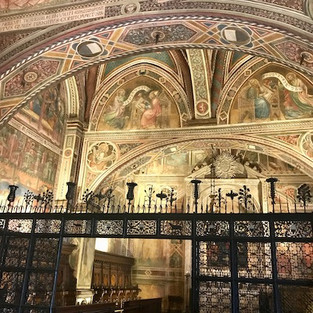
The chapel has gorgeous wrought-iron screen and gates as well as beautifully painted walls and ceilings.
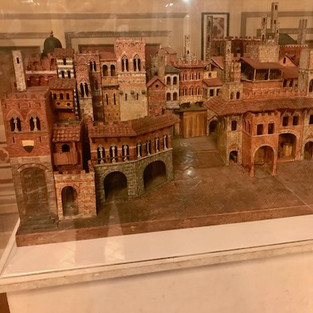
In the third image below, there's a wonderful little model of the city (or some city), but I couldn't find any explanatory information about it.
Overall, definitely a three-star attraction.











Comments